Many people think that buying "organic" is the be all and end of all of all they need to know about purchasing their food. This is not true. It says nothing about how the animals are kept or treated. It is just common sense that if you stuff thousands of hens together you will get disease. Perhaps it is the hens revenge on us for treating them so badly. We should pay attention. It doesn't have to be this way.
Reprinted from the Grist website
www.gristmill.grist.org
The case for sustainable grown food as a healthier and safer alternative to industrial dreck is gaining force. Here's the latest, from Natural Choices UK:
www.naturalchoices.co.uk/
A recent U.K.government survey shows that organic laying hen farms have a significantly lower level of Salmonella. Salmonella is a bacterium that causes one of the commonest forms of food poisoning worldwide. The study showed that 23.4 per cent of farms with caged hens tested positive for salmonella compared to 4.4 per cent in organic flocks and 6.5 per cent in free-range flocks.
U.K. organic standards are run by an NGO called the Soil Association, which creates rules with consumers and smallish farmers in mind, not industrial giants. "The Soil Association insists on higher welfare standards for organic poultry than most other organic certifiers," the group declares in its organic-egg standards. The Association insists that hens be "truly free range," "looked after in small flocks," and have ample access to "fresh grass and air."
www.soilassociation.org
Our own USDA organic standards are much more concerned about how giant operations can cash in on the organic craze. So all we get on animal standards is that "All organically raised animals must have access to the outdoors" -- a stipulation that has been subject to much, well, chicanery. Michael Pollan found "organic" hens stuffed into pens for his Omnivore's Dilemma research, their "access to outdoors" amounting to an unutilized concrete patch. www.ams.usda.gov/nop/FactSheets/ProdHandE.html
And the Cornucopia Foundation has documented that large-scale "organic" dairies for years stuffed cows into confinements and feed them (organic) corn. www.commondreams.org/news2007/0607-11.htm/
As for salmonella and eggs, the issue seems to be about whether the hens are wallowing in their own feces. So if a large portion of U.S. organic layers are doing just that, it seems doubtful that our own supermarket organic eggs can offer the same benefit as those in the U.K. The egg study comes on the heels of a peer-reviewed U.K. study showing that organic milk cuts "the incidence of eczema in infants fed on organic dairy products, and whose mothers also consumed organic dairy products," by 36 percent.
Saturday, February 23, 2008


Wednesday, February 20, 2008
Biggest recall of frozen beef in U.S. history
By now most folks have seen the video on UTube that was released by the Humane Society of the U.S. It shows workers at the Hallmark/Westland Meet Packing Co. kicking cows and using electric prods and forklifts to make them move. People who saw the video say it was sickening. I don't need to look, I know, and this is why i don't buy commercial lot meat.
Whle these acts are violations of a 2003 prohibition on downer cattle from entering the food supply as a precaution against mad-cow disease. The real reason for the recall should be INHUMANE TREATMENT OF ANIMALS.
According to public records, the privately held company was founded in 1985 in what is known as the Chino milkshed. The company has 200 employees and sells beef to institutional vendors such as the USDA's school lunch program and fast-food restaurants, including Southern California icons In-N-Out Burger and Jack in the Box.
Last year, the federal government purchased nearly $39 million of ground beef from Westland/Hallmark at an average price of $1.42 a pound. That represented about 40% of the company's roughly $100 million in annual sales, according to industry sources. There are very few inspectors at the USDA to check out plants. By reducing their budget the government is ensuring that this type of behavior continues so that they can buy cheap beef. Don't support it!!!
The heart of the matter is that meat can only be cheap if you fatten up animals quickly, polluate the water and land, speed up the lines to the degree that workers and animals suffer grave injuries and then you can have your cheap meat. But even then, it comes at as price which most folks are unwilling to think about and that is your long term health in eating this kind of meat.
While two staff members have been charged with animal cruelty all the owners of Hallmark need to be tried. Companies follow the lead of the CEO and the Executive Committee. Do NOT SUPPORT THIS COMPANY instead support the efforts of the Humane Society of America.
The list of products to avoid now and in the future is very long. However look at meat packages for the words WESTLAND MEAT CO or PACKED FOR: KING MEAT CO. Alternatively buy your meat from reputable sources...they do exist.
Whle these acts are violations of a 2003 prohibition on downer cattle from entering the food supply as a precaution against mad-cow disease. The real reason for the recall should be INHUMANE TREATMENT OF ANIMALS.
According to public records, the privately held company was founded in 1985 in what is known as the Chino milkshed. The company has 200 employees and sells beef to institutional vendors such as the USDA's school lunch program and fast-food restaurants, including Southern California icons In-N-Out Burger and Jack in the Box.
Last year, the federal government purchased nearly $39 million of ground beef from Westland/Hallmark at an average price of $1.42 a pound. That represented about 40% of the company's roughly $100 million in annual sales, according to industry sources. There are very few inspectors at the USDA to check out plants. By reducing their budget the government is ensuring that this type of behavior continues so that they can buy cheap beef. Don't support it!!!
The heart of the matter is that meat can only be cheap if you fatten up animals quickly, polluate the water and land, speed up the lines to the degree that workers and animals suffer grave injuries and then you can have your cheap meat. But even then, it comes at as price which most folks are unwilling to think about and that is your long term health in eating this kind of meat.
While two staff members have been charged with animal cruelty all the owners of Hallmark need to be tried. Companies follow the lead of the CEO and the Executive Committee. Do NOT SUPPORT THIS COMPANY instead support the efforts of the Humane Society of America.
The list of products to avoid now and in the future is very long. However look at meat packages for the words WESTLAND MEAT CO or PACKED FOR: KING MEAT CO. Alternatively buy your meat from reputable sources...they do exist.
Sunday, February 10, 2008
Immigrant Farmers: Resources and Accessibility
There are over twenty established and developing immigrant farming projects in the U.S. that provide resources to farmers. Many of the organizations work together in such a manner that they are not recreating the wheel but creating total new initiates or improving existing ones. Individual programs or organizations can be found under umbrella organizations listed at the end of this article so be sure to check them out. In this article I focus on the NFDP program.
New Farmer Development Program
The New Farmer Development Program (NFDP) under the City Council on the Environment of New York City has been instrumental in helping farmers from Latin America (Chile, Colombia, Costa Rica, Dominican Republic, Ecuador, Honduras, Mexico, Peru, Puerto Rico, and Uruguay) get started. This program was created in 2000 as a partnership between Greenmarket and Cornell Cooperative Extension’s NYC Program and is based in New York City. As such it supports farmers within the city, Hudson Valley, the Catskill Regions, New Jersey and northeastern Pennsylvania. The USDA Risk Management Agency made a large sum of money available to train immigrant farmers in 2000. After the 9/11/2001 attack some people wondered aloud about the security of our major highways as it related to food transportation. If one or two of our major highways in the northeast was put out of commission our access to food would be severely impacted. Thus preserving local farmland and strengthening our regional food security is really important and now with the cost of oil an economic issue too.
La Nueva Siembra (“a New Season”) is the NFDP’s comprehensive spring training course consisting of twelve three-hour classes offered weekly from June through August. The course introduces participants to regional farming conditions, sustainable agricultural practices, local marketing opportunities, land, equipment, and federal and state agricultural support programs for new and socially disadvantaged farmers. In addition to La Nueva Siembra, the NFDP offers workshops each year at local farms where project participants gain hands-on technical experience on topics identified by the farmers themselves.
Over the past five years, NFDP have been able to focus their training curriculum on the topics that are most critical to new immigrant farmers, such as local production schedules and techniques, basic equipment and machinery for new farmers, integrated pest management and organic standards, and direct marketing standards.
When new participants graduate from La Nueva Siembra, training farms in the city and neighboring counties provide an intermediate step as they move toward independent farming. The NFDP also facilitates mentorship’s for project participants with established local farmers. A mentorship provides participants with an opportunity to partner with an experienced local farmer and benefit from their expertise. Once they are ready to start their own farm business, NFDP helps them identify appropriate farmland for lease or sale through their broad partner base, introduce them to local farmers markets, provide access to NFDP participant-managed microcredit funds, and offer intensive technical support.
Funding sources to support this effort come from the USDA Risk Management Agency, the USDA Cooperative State Research, Extension, and Education Service; Heifer International, Jessie Smith Noyes Foundation, J.M. Kaplan Foundation, Louis and Anne Abrons Foundation, and The City of New York
The NFDP has graduated 130 members since its inception and 17 individuals and their families have started their own farming businesses. These farmers come from countries such as Columbia, the Dominican Republic, Ecuador and Mexico. Out of the 130 people that have graduated 30% have gone on to farm in some way on project training sites, established local farms with mentor farmers, or their own independent farms. The remaining 70% have gone on to work with community gardening organizations or have started their own gardens, while others have simply decided that farming or gardening was not the right decision for them.
Once farmers graduate and begin farming they tend to raise traditional ethnic produce in addition to the more usual fruits and vegetables. Mexican specialty crops such as papalo, pipicha, alache, epazote, huazontle, and squash blossoms are particularly popular with farmers and their customers. However, as these products are largely unfamiliar to most customers they won’t buy them in any kind of quantity, and thus farmers tend to only sell these products in neighborhoods with a large Mexican community.
Even though the farmers’ were taught basic book keeping and finance it is felt that very few of them actually keep records. For those that don’t, they learn very quickly through their own experience and the experience of other farmers what sells and what doesn’t. Also, as farmers build a steady and loyal clientele, customers will ask for specific products that they can’t find anywhere else.
For the immigrant farmers’ in this program only about 25% of them manage to make 100%of their income from farming and the rest hold down winter jobs. This is most likely because they have to rent land from other farmers. All the farmers own and operate their own, independent farm business, so they invest their own money, labor, and time into building that business. The NFDP simply provides access to information and resources, and serves as an advocate for the farmer when necessary. Since the inception of the program, one NFDP farmer has been able to purchase his land, and two more are hoping to do so in 2008.
Tello’s Green Farm
Walking around the village looking for somewhere not crowded to eat lunch I came up a Quartino, an organic and vegetarian restaurant on Bleecker Street that had a statement on the window menu that all their egg dishes where made from local eggs. This looked like a very promising sign of a good restaurant so I walked in and indeed I was not disappointed. I asked the waitress where the eggs came from and she said Tello’s green Farm, another plus for the resturant; the staff knew the sources of the produce. After lunch, I procedured to Greenmarket to interview folks for this piece and low and behold there was Tello’s farm stand at the market.
Nestor Tello was part of the first batch of farmers to graduate from the program in 2001. In Columbia he had worked with relatives on farms before he decided to become a veterinarian. Then in 1992 he moved to Brooklyn, NY. In 2000 he had the good fortune to read about the NFDP farming program in a Spanish-language newspaper El Diario and applied.
Nestor and Alejandra started off with 400 hens on land that was several hours away from where they lived in Brooklyn. So each day they had to travel from their home in Brooklyn to the farm where they were trying to get established and juggle full-time jobs. By the second year however, they were able to move to a closer farm site in the Hudson Valley and quit their jobs and take on farming full-time. Nestor rents his land but does have an advantage of a long term agreement with his landlord. In 2002, their chicken coop collapsed under the weight of heavy winter snows and they lost everything. They were devastated after so much hard work and things looked very bleak. However, the NFDP had been working with its participants to create a small loan program for its farmers based on the Heifer “Passing on the Gift” model. The Tellos’ received a “loan” of 2,000 laying hens.
Today they have 4,000 which are raised on 5-acres of land with another two acres reserved for growing vegetables. The hens are raised the way nature intended; on pasture. Every noontime they are let out of their chicken house until dusk and peck around eating grass and whatever else they can find on the ground along with corn. When I met Nestor at the Union Sq. market he told me that, “When I have my hens free, I don’t need to give them extra vitamins, antibiotics or hormones because they already have that support naturally.” Most of Nestor’s flock is Rhode Island Reds with some Araucana which are very popular because of their blue egg shells. He manages his farm with his wife and two Central American workers.
Making the connections
Connections were initially made when Nestor met chefs who were coming to the farmers markets (especially Union Square) to buy produce for their restaurants. He got started with a few chefs this way. Then, as chefs or other restaurant staff members moved to new restaurants or started their own restaurants, he maintained the connection and was able to develop new buyers through his old relationships. .
Resources
USDA Risk Management Agency –
rma.usda.gov/aboutrma/agreements/
USDA Cooperative State Research, Extension, and Education Service; - csrees.usda.gov/fo/funding.cfm
Heifer International –
heifer.org/site/c.ededJRKQNiFiG/b.485969
Jessie Smith Noyes Foundation –
noyes.org
J.M. Kaplan Foundation –
jmkfund.org
Louis and Anne Abrons Foundation,
The City of New York
New Farmer Development Program
The New Farmer Development Program (NFDP) under the City Council on the Environment of New York City has been instrumental in helping farmers from Latin America (Chile, Colombia, Costa Rica, Dominican Republic, Ecuador, Honduras, Mexico, Peru, Puerto Rico, and Uruguay) get started. This program was created in 2000 as a partnership between Greenmarket and Cornell Cooperative Extension’s NYC Program and is based in New York City. As such it supports farmers within the city, Hudson Valley, the Catskill Regions, New Jersey and northeastern Pennsylvania. The USDA Risk Management Agency made a large sum of money available to train immigrant farmers in 2000. After the 9/11/2001 attack some people wondered aloud about the security of our major highways as it related to food transportation. If one or two of our major highways in the northeast was put out of commission our access to food would be severely impacted. Thus preserving local farmland and strengthening our regional food security is really important and now with the cost of oil an economic issue too.
La Nueva Siembra (“a New Season”) is the NFDP’s comprehensive spring training course consisting of twelve three-hour classes offered weekly from June through August. The course introduces participants to regional farming conditions, sustainable agricultural practices, local marketing opportunities, land, equipment, and federal and state agricultural support programs for new and socially disadvantaged farmers. In addition to La Nueva Siembra, the NFDP offers workshops each year at local farms where project participants gain hands-on technical experience on topics identified by the farmers themselves.
Over the past five years, NFDP have been able to focus their training curriculum on the topics that are most critical to new immigrant farmers, such as local production schedules and techniques, basic equipment and machinery for new farmers, integrated pest management and organic standards, and direct marketing standards.
When new participants graduate from La Nueva Siembra, training farms in the city and neighboring counties provide an intermediate step as they move toward independent farming. The NFDP also facilitates mentorship’s for project participants with established local farmers. A mentorship provides participants with an opportunity to partner with an experienced local farmer and benefit from their expertise. Once they are ready to start their own farm business, NFDP helps them identify appropriate farmland for lease or sale through their broad partner base, introduce them to local farmers markets, provide access to NFDP participant-managed microcredit funds, and offer intensive technical support.
Funding sources to support this effort come from the USDA Risk Management Agency, the USDA Cooperative State Research, Extension, and Education Service; Heifer International, Jessie Smith Noyes Foundation, J.M. Kaplan Foundation, Louis and Anne Abrons Foundation, and The City of New York
The NFDP has graduated 130 members since its inception and 17 individuals and their families have started their own farming businesses. These farmers come from countries such as Columbia, the Dominican Republic, Ecuador and Mexico. Out of the 130 people that have graduated 30% have gone on to farm in some way on project training sites, established local farms with mentor farmers, or their own independent farms. The remaining 70% have gone on to work with community gardening organizations or have started their own gardens, while others have simply decided that farming or gardening was not the right decision for them.
Once farmers graduate and begin farming they tend to raise traditional ethnic produce in addition to the more usual fruits and vegetables. Mexican specialty crops such as papalo, pipicha, alache, epazote, huazontle, and squash blossoms are particularly popular with farmers and their customers. However, as these products are largely unfamiliar to most customers they won’t buy them in any kind of quantity, and thus farmers tend to only sell these products in neighborhoods with a large Mexican community.
Even though the farmers’ were taught basic book keeping and finance it is felt that very few of them actually keep records. For those that don’t, they learn very quickly through their own experience and the experience of other farmers what sells and what doesn’t. Also, as farmers build a steady and loyal clientele, customers will ask for specific products that they can’t find anywhere else.
For the immigrant farmers’ in this program only about 25% of them manage to make 100%of their income from farming and the rest hold down winter jobs. This is most likely because they have to rent land from other farmers. All the farmers own and operate their own, independent farm business, so they invest their own money, labor, and time into building that business. The NFDP simply provides access to information and resources, and serves as an advocate for the farmer when necessary. Since the inception of the program, one NFDP farmer has been able to purchase his land, and two more are hoping to do so in 2008.
Tello’s Green Farm
Walking around the village looking for somewhere not crowded to eat lunch I came up a Quartino, an organic and vegetarian restaurant on Bleecker Street that had a statement on the window menu that all their egg dishes where made from local eggs. This looked like a very promising sign of a good restaurant so I walked in and indeed I was not disappointed. I asked the waitress where the eggs came from and she said Tello’s green Farm, another plus for the resturant; the staff knew the sources of the produce. After lunch, I procedured to Greenmarket to interview folks for this piece and low and behold there was Tello’s farm stand at the market.
Nestor Tello was part of the first batch of farmers to graduate from the program in 2001. In Columbia he had worked with relatives on farms before he decided to become a veterinarian. Then in 1992 he moved to Brooklyn, NY. In 2000 he had the good fortune to read about the NFDP farming program in a Spanish-language newspaper El Diario and applied.
Nestor and Alejandra started off with 400 hens on land that was several hours away from where they lived in Brooklyn. So each day they had to travel from their home in Brooklyn to the farm where they were trying to get established and juggle full-time jobs. By the second year however, they were able to move to a closer farm site in the Hudson Valley and quit their jobs and take on farming full-time. Nestor rents his land but does have an advantage of a long term agreement with his landlord. In 2002, their chicken coop collapsed under the weight of heavy winter snows and they lost everything. They were devastated after so much hard work and things looked very bleak. However, the NFDP had been working with its participants to create a small loan program for its farmers based on the Heifer “Passing on the Gift” model. The Tellos’ received a “loan” of 2,000 laying hens.
Today they have 4,000 which are raised on 5-acres of land with another two acres reserved for growing vegetables. The hens are raised the way nature intended; on pasture. Every noontime they are let out of their chicken house until dusk and peck around eating grass and whatever else they can find on the ground along with corn. When I met Nestor at the Union Sq. market he told me that, “When I have my hens free, I don’t need to give them extra vitamins, antibiotics or hormones because they already have that support naturally.” Most of Nestor’s flock is Rhode Island Reds with some Araucana which are very popular because of their blue egg shells. He manages his farm with his wife and two Central American workers.
Making the connections
Connections were initially made when Nestor met chefs who were coming to the farmers markets (especially Union Square) to buy produce for their restaurants. He got started with a few chefs this way. Then, as chefs or other restaurant staff members moved to new restaurants or started their own restaurants, he maintained the connection and was able to develop new buyers through his old relationships. .
Resources
USDA Risk Management Agency –
rma.usda.gov/aboutrma/agreements/
USDA Cooperative State Research, Extension, and Education Service; - csrees.usda.gov/fo/funding.cfm
Heifer International –
heifer.org/site/c.ededJRKQNiFiG/b.485969
Jessie Smith Noyes Foundation –
noyes.org
J.M. Kaplan Foundation –
jmkfund.org
Louis and Anne Abrons Foundation,
The City of New York
Wednesday, February 6, 2008
Integrated Pest Management
According to the Massachusetts Commissioner of Food and Agriculture, Jay Healy “a great majority of Massachusetts growers are strong proponents and users of IMP.” Since its adoption by our state’s farmers the use of pesticides has decreased by 50% from historic levels. IPM is the process of monitoring crops, the pests, and the weather and spraying only when conditions dictate.
IPM is a combination of four different techniques to prevent pest damage. The first two methods have been used since time immemorial. These techniques are:
- modifying pest habitat
- protecting natural enemies
- monitoring
- pesticides
When farmers rotate their plant crops from field to field so they are not planting the same crops in the same fields each season they are using a method of habitat modification. Keeping pests away from their basic needs of feed, shelter and water is another. This is done by closing doors and keeping window screens in good repair and cleaning up spills and crumbs which all limits their access to food and water.
Protecting natural enemies by using natural predators such as ladybird beetles in greenhouses for protecting the widely used ornamental exotic species of plants known as euonymus. These beetles have a voracious appetite for Euonymus scale, a pest that destroys these plants. Other examples are wasps that reduce silverleaf whiteflies on our favorite Christmas plants: poinsettias, and bacteria-based pesticides.
Monitoring pest populations allows practitioners to avoid unnecessary treatments. Various sticky traps are used on trees by many farmers. Soil sampling is done on a regular basis (weekly or monthly) and plant leaves are checked for disease. When disease reaches a certain level then pesticides come into play.
Chemicals or pesticides are only used when needed and other methods will not work. Under the IPM system the least hazardous pesticide and the lowest effective amount should be used.
Partners with Nature label serves to encourage growers to use IPM and educate consumers about it. While this is a Massachusetts label there are hopes in the future for a national label.
Before you completely rule out food grown using this method, take a minute to consider how much pesticide and chemicals you use on your kitchen counters, in your bathroom, and on your lawn.
IPM is a combination of four different techniques to prevent pest damage. The first two methods have been used since time immemorial. These techniques are:
- modifying pest habitat
- protecting natural enemies
- monitoring
- pesticides
When farmers rotate their plant crops from field to field so they are not planting the same crops in the same fields each season they are using a method of habitat modification. Keeping pests away from their basic needs of feed, shelter and water is another. This is done by closing doors and keeping window screens in good repair and cleaning up spills and crumbs which all limits their access to food and water.
Protecting natural enemies by using natural predators such as ladybird beetles in greenhouses for protecting the widely used ornamental exotic species of plants known as euonymus. These beetles have a voracious appetite for Euonymus scale, a pest that destroys these plants. Other examples are wasps that reduce silverleaf whiteflies on our favorite Christmas plants: poinsettias, and bacteria-based pesticides.
Monitoring pest populations allows practitioners to avoid unnecessary treatments. Various sticky traps are used on trees by many farmers. Soil sampling is done on a regular basis (weekly or monthly) and plant leaves are checked for disease. When disease reaches a certain level then pesticides come into play.
Chemicals or pesticides are only used when needed and other methods will not work. Under the IPM system the least hazardous pesticide and the lowest effective amount should be used.
Partners with Nature label serves to encourage growers to use IPM and educate consumers about it. While this is a Massachusetts label there are hopes in the future for a national label.
Before you completely rule out food grown using this method, take a minute to consider how much pesticide and chemicals you use on your kitchen counters, in your bathroom, and on your lawn.
Sunday, January 20, 2008
The River Cottage Meat Cook
by Hugh Fearnley-Whittingstall
Ok! So I promise I did not buy the book I just looked at it out of interest. This is a heavy coffee table book weighing in at 543 pages. Over half of the pages are dedicated to FW’s philosophy on animal rearing, slaughtering and eating. The book is profusely illustrated from slaughtering a cow, to roasting a whole pig, to preparing the cuts of meat, and the step by step process of making a pork pie. There is a page of photographs showing the death of a cow; the first photograph shows a gun between the steers of a cow, then the dead animal with blood, it being hung, and then cut up into pieces, etc. With good reason these photographs are placed at the beginning of the book. FW is making his point right up front and the text supports those feelings. So you will either stop right there and put the book back on the shelf or not. I also think that many readers might not be happy to see a hare in a plastic shopping bag all in one piece with its head and paws. Actually to me it looks alive except of course it would not be sitting calmly in a plastic bag waiting to be dinner for someone.
FW puts forward issues that I agree with and those I don't. But at least he is talking about the issues and has very definate opinions. I particularly agree with the fact that meat should not be cheap. When we pay a lot of money for something than indeed we all ask questions about the why and the wherefore; what was the animal fed on, how did it live, and how did it die. If we are happy with the answers we pay more for the product and this is how it should be. And to answer the question "what about people with little money" just eat less and eat the cheaper cuts that most Americans don't even look at.
The book brings to the forefront yet again whether I should be eating meat. In actual fact, after looking at these pictures I have to ask myself if taking the life of a perfectly healthy and happy animal to feed me, when I could eat plenty of other things is morally correct. If we were all closer to the meat that we eat I think many more people would question what they eat. So as you can see, I am completely torn in two on the issue and when it will be solved I have no idea.
Many of the recipes in the book are for 6-10 people and while it is easy to cut some recipes into a quarter, others it is not. Additionally, the meat items that he lists as cheap are not so in America. For example there is a picture showing the cost of locally farmed Lamb Shanks at three English pounds a pound (about six dollars at the current exchange rate). I pay 50-100% more depending on the farmer I buy it from. He also lists wild rabbit under cheap and pig trotters. Now the former is very expensive and the latter is impossible to find as I do not know of any butcher in or around Boston. To clarify: a butcher is a person who has the whole animal in his store/refrigerator and will cut the pieces that you want to order. I do know that I could find everything at Blood Farms in Groton, MA because it is a small family slaughterhouse.
If you want to know how to cure meats, and make sausages, pates and terrines there is a whole chapter dedicated to just that. In fact, this book is excellent for the folks who want to know how to cut up various animals and fowl and what to do with all the pieces.
Under meals that are kid friendly he has Lamb braised with stuffed vine leaves, Indian-spiced Lamb Skewers, Flying Toad in the Hole, and Souvlaki to name a few. This brought back memories of the time I invited my neighbors and their two kids to dinner. I served roast lamb, roast potatoes, and Brussels sprouts. They eat half a potato. They had never had lamb, where not sure what the potatoes were (they were roasted in the fat of the lamb until they were crisp on the outside) and obviously didn’t eat vegetables. They were much relieved when I served Apple Pie with ice cream and said “thank goodness an American dessert.” However, their smile didn’t last long as I put a dollop of ice cream on each slice of pie and then put the ice cream back in the refrigerator. Apparently they though they were going to eat the entire pint of ice cream which I planned on lasting me the month.
There are some classic British recipes that I recall as a kid. I disagree with using beef kidneys for the steak and kidney pie because I feel that they are too strong and that veal kidneys provide a much better flavor. I was happy to see Lancashire Hot Pot in the book, a dish I have fond memories of as a child. My grandmother made this for me frequently and I still remember the brown pot it was made in and how the small the kitchen was that she cooked.
Ok! So I promise I did not buy the book I just looked at it out of interest. This is a heavy coffee table book weighing in at 543 pages. Over half of the pages are dedicated to FW’s philosophy on animal rearing, slaughtering and eating. The book is profusely illustrated from slaughtering a cow, to roasting a whole pig, to preparing the cuts of meat, and the step by step process of making a pork pie. There is a page of photographs showing the death of a cow; the first photograph shows a gun between the steers of a cow, then the dead animal with blood, it being hung, and then cut up into pieces, etc. With good reason these photographs are placed at the beginning of the book. FW is making his point right up front and the text supports those feelings. So you will either stop right there and put the book back on the shelf or not. I also think that many readers might not be happy to see a hare in a plastic shopping bag all in one piece with its head and paws. Actually to me it looks alive except of course it would not be sitting calmly in a plastic bag waiting to be dinner for someone.
FW puts forward issues that I agree with and those I don't. But at least he is talking about the issues and has very definate opinions. I particularly agree with the fact that meat should not be cheap. When we pay a lot of money for something than indeed we all ask questions about the why and the wherefore; what was the animal fed on, how did it live, and how did it die. If we are happy with the answers we pay more for the product and this is how it should be. And to answer the question "what about people with little money" just eat less and eat the cheaper cuts that most Americans don't even look at.
The book brings to the forefront yet again whether I should be eating meat. In actual fact, after looking at these pictures I have to ask myself if taking the life of a perfectly healthy and happy animal to feed me, when I could eat plenty of other things is morally correct. If we were all closer to the meat that we eat I think many more people would question what they eat. So as you can see, I am completely torn in two on the issue and when it will be solved I have no idea.
Many of the recipes in the book are for 6-10 people and while it is easy to cut some recipes into a quarter, others it is not. Additionally, the meat items that he lists as cheap are not so in America. For example there is a picture showing the cost of locally farmed Lamb Shanks at three English pounds a pound (about six dollars at the current exchange rate). I pay 50-100% more depending on the farmer I buy it from. He also lists wild rabbit under cheap and pig trotters. Now the former is very expensive and the latter is impossible to find as I do not know of any butcher in or around Boston. To clarify: a butcher is a person who has the whole animal in his store/refrigerator and will cut the pieces that you want to order. I do know that I could find everything at Blood Farms in Groton, MA because it is a small family slaughterhouse.
If you want to know how to cure meats, and make sausages, pates and terrines there is a whole chapter dedicated to just that. In fact, this book is excellent for the folks who want to know how to cut up various animals and fowl and what to do with all the pieces.
Under meals that are kid friendly he has Lamb braised with stuffed vine leaves, Indian-spiced Lamb Skewers, Flying Toad in the Hole, and Souvlaki to name a few. This brought back memories of the time I invited my neighbors and their two kids to dinner. I served roast lamb, roast potatoes, and Brussels sprouts. They eat half a potato. They had never had lamb, where not sure what the potatoes were (they were roasted in the fat of the lamb until they were crisp on the outside) and obviously didn’t eat vegetables. They were much relieved when I served Apple Pie with ice cream and said “thank goodness an American dessert.” However, their smile didn’t last long as I put a dollop of ice cream on each slice of pie and then put the ice cream back in the refrigerator. Apparently they though they were going to eat the entire pint of ice cream which I planned on lasting me the month.
There are some classic British recipes that I recall as a kid. I disagree with using beef kidneys for the steak and kidney pie because I feel that they are too strong and that veal kidneys provide a much better flavor. I was happy to see Lancashire Hot Pot in the book, a dish I have fond memories of as a child. My grandmother made this for me frequently and I still remember the brown pot it was made in and how the small the kitchen was that she cooked.
What Have They Done to My Bread?
All you need to make bread is yeast, water, and flour. Therefore, what makes sliced bread so light and fluffy and last so long? Looking at the ingredients on the plastic wrap I found a whole pile of ingredients that I had no clue what they were. My philosophy in buying food is that if you don’t know what the ingredients are you don’t buy it or eat it.
After some investigation, I found that in the late 1950s the U.S. discovered a way to avoid the centuries’ old process of making bread that required 2-3 hours of fermentation. They did this by incorporating air and water into dough and mixing it with intense energy in high speed mechanical mixers. This process however required the quantity of yeast to be doubled to make it rise; chemical oxidants to get the gas in; and hardened fat to provide the structure – without the fat, the bread collapsed in early experiments – but the process removed the intensive labor, reduced costs and provided much higher yields of bread from each sack of flour as the dough absorbed so much more water.
Chemical oxidants were incorporated into a premix of additives with soya flour as the carrier for the chemical ingredients. The improver or ‘flour treatment agent’ was the logical way to add the fats needed into the bread. Hydrogenated fat is used because of its high melting point that gives the bread the structure it needs; Hydrogenated fat contains trans-fat.
As the “process” involved it was found that emulsifiers provided a similar function to the fat. They plug the gaps, enabling the dough to retain more air while also slowing down the staling of the bread. The most commonly used group of emulsifiers in bread is the data esters, relatively novel and complex compounds, made from petrochemicals. Salt goes into the bread to add flavor, up to 0.5g per 100g for white sliced, making it a high-salt food.
In the late 1990s, many western governments banned the use of chlorine to bleach white bread which led manufacturers to find alternatives such as enzymes and other novel ingredients. Enzymes have been used for centuries in food preparation but today many of them used in baking today are produced by genetically modified organisms. It is the microorganisms that produce the enzymes however, rather than the enzymes themselves, that have been modified. As enzymes are destroyed in the baking process it does not needed to be listed on the label, because they are not there!. The bread is then finished off by spraying it with either potassium sorbate or calcium propionate – both antifungal agents which inhabit the growth of moulds. Potassium sorbate is a poly unsaturated fatty acid salt. Do you really want to eat this kind of bread?
So this is what goes into the packaged, sliced white loaf of bread but what’s taken out?
The whole grain consists of an outer fibrous layer of bran; the germ and the inner white endosperm. The bran contains the fibre, some protein, fats and minerals. The germ contains most of the oils, some protein and the highest concentration of vitamins and minerals. The endosperm is mostly carbohydrate and some protein. The oil of the whole grain has traditionally been one of the most important sources in the diet of essential fats, which are vital for a healthy brain and nervous tissue function, but when whole wheat is milled to white flour, the most nutritious part of the grain is taken away. During the milling of white flour, over twenty vitamins and minerals present in the original wheat grain are reduced by half or more.
When you stone-grind flour the grain goes in at the top and comes out the side twenty seconds later. You know you have the whole lot. Also white flour can be matured by careful storage and does not need additives and enzymes. For thousands of years grain was milled this way. It’s a relative gentle process that leaves most of the nutrients intact. But a pair of stones can only grind 250 kilos of flour an hour which is why commercial bakeries have abandoned the process. While you can get excellent bread made from scratch from local independent bakeries, most purchase their flour from the big agribusinesses such as General Mills. Make sure you know what kind of flour was used in your bread.
Don’t forget too that there is extensive use of Pesticides and Fertilizers on wheat. Some of the main chemicals (insecticides, herbicides and fungicides) used on commercial wheat crops are disulfoton (Di-syston), methyl parathion, chlorpyrifos, dimethoate, diamba and glyphosate. Although all these chemicals are approved for use and considered safe, consumers are wise to reduce their exposure as much as possible. Besides contributing to the overall toxic load in our bodies, these chemicals increase our susceptibility to neuro toxic diseases as well as to conditions like cancer. Many of these pesticides function as xenoestrogens, foreign estrogen that can reap havoc with our hormone balance and may be a contributing factor to a number of health conditions. For example, researchers speculate these estrogen-mimicking chemicals are one of the contributing factors to boys and girls entering puberty at earlier and earlier ages. They have also been linked to abnormalities and hormone-related cancers including fibrocystic breast disease, breast cancer and endometriosis.
Much of this article was rewritten or excepted from Not On The Label by Felicity Lawrence; chapter four
Sources
http://www.mercola.com/2003/jul/26/avoid_wheat.htmf
http://www.weightlossresources.co.uk/food/labelling/not_on_the_label.htm
http://www.corpwatch.org/article.php?id=11712
http://www.findarticles.com/p/articles/mi_qa3675/is_199606/ai_n8747244#continue
http://www.arrowheadmills.com/products/category.php?cat_id=63
http://commentisfree.guardian.co.uk/felicity_lawrence/profile.html
After some investigation, I found that in the late 1950s the U.S. discovered a way to avoid the centuries’ old process of making bread that required 2-3 hours of fermentation. They did this by incorporating air and water into dough and mixing it with intense energy in high speed mechanical mixers. This process however required the quantity of yeast to be doubled to make it rise; chemical oxidants to get the gas in; and hardened fat to provide the structure – without the fat, the bread collapsed in early experiments – but the process removed the intensive labor, reduced costs and provided much higher yields of bread from each sack of flour as the dough absorbed so much more water.
Chemical oxidants were incorporated into a premix of additives with soya flour as the carrier for the chemical ingredients. The improver or ‘flour treatment agent’ was the logical way to add the fats needed into the bread. Hydrogenated fat is used because of its high melting point that gives the bread the structure it needs; Hydrogenated fat contains trans-fat.
As the “process” involved it was found that emulsifiers provided a similar function to the fat. They plug the gaps, enabling the dough to retain more air while also slowing down the staling of the bread. The most commonly used group of emulsifiers in bread is the data esters, relatively novel and complex compounds, made from petrochemicals. Salt goes into the bread to add flavor, up to 0.5g per 100g for white sliced, making it a high-salt food.
In the late 1990s, many western governments banned the use of chlorine to bleach white bread which led manufacturers to find alternatives such as enzymes and other novel ingredients. Enzymes have been used for centuries in food preparation but today many of them used in baking today are produced by genetically modified organisms. It is the microorganisms that produce the enzymes however, rather than the enzymes themselves, that have been modified. As enzymes are destroyed in the baking process it does not needed to be listed on the label, because they are not there!. The bread is then finished off by spraying it with either potassium sorbate or calcium propionate – both antifungal agents which inhabit the growth of moulds. Potassium sorbate is a poly unsaturated fatty acid salt. Do you really want to eat this kind of bread?
So this is what goes into the packaged, sliced white loaf of bread but what’s taken out?
The whole grain consists of an outer fibrous layer of bran; the germ and the inner white endosperm. The bran contains the fibre, some protein, fats and minerals. The germ contains most of the oils, some protein and the highest concentration of vitamins and minerals. The endosperm is mostly carbohydrate and some protein. The oil of the whole grain has traditionally been one of the most important sources in the diet of essential fats, which are vital for a healthy brain and nervous tissue function, but when whole wheat is milled to white flour, the most nutritious part of the grain is taken away. During the milling of white flour, over twenty vitamins and minerals present in the original wheat grain are reduced by half or more.
When you stone-grind flour the grain goes in at the top and comes out the side twenty seconds later. You know you have the whole lot. Also white flour can be matured by careful storage and does not need additives and enzymes. For thousands of years grain was milled this way. It’s a relative gentle process that leaves most of the nutrients intact. But a pair of stones can only grind 250 kilos of flour an hour which is why commercial bakeries have abandoned the process. While you can get excellent bread made from scratch from local independent bakeries, most purchase their flour from the big agribusinesses such as General Mills. Make sure you know what kind of flour was used in your bread.
Don’t forget too that there is extensive use of Pesticides and Fertilizers on wheat. Some of the main chemicals (insecticides, herbicides and fungicides) used on commercial wheat crops are disulfoton (Di-syston), methyl parathion, chlorpyrifos, dimethoate, diamba and glyphosate. Although all these chemicals are approved for use and considered safe, consumers are wise to reduce their exposure as much as possible. Besides contributing to the overall toxic load in our bodies, these chemicals increase our susceptibility to neuro toxic diseases as well as to conditions like cancer. Many of these pesticides function as xenoestrogens, foreign estrogen that can reap havoc with our hormone balance and may be a contributing factor to a number of health conditions. For example, researchers speculate these estrogen-mimicking chemicals are one of the contributing factors to boys and girls entering puberty at earlier and earlier ages. They have also been linked to abnormalities and hormone-related cancers including fibrocystic breast disease, breast cancer and endometriosis.
Much of this article was rewritten or excepted from Not On The Label by Felicity Lawrence; chapter four
Sources
http://www.mercola.com/2003/jul/26/avoid_wheat.htmf
http://www.weightlossresources.co.uk/food/labelling/not_on_the_label.htm
http://www.corpwatch.org/article.php?id=11712
http://www.findarticles.com/p/articles/mi_qa3675/is_199606/ai_n8747244#continue
http://www.arrowheadmills.com/products/category.php?cat_id=63
http://commentisfree.guardian.co.uk/felicity_lawrence/profile.html
Monday, January 14, 2008
Saturday Morning Market - St. Petersburg, FL
Recently on a trip to St. Petersburg, Florida I was told about a greenmarket that was held in the town center every Saturday during the winter months. So off I went to check it out as I love fresh food and the camaraderie of farmers’ markets I paid it a visit. My first impression was::
- There were few produce vendors and even less local produce vendors
- It was not a farmers’ market
- It was very crowded, lively and fun
- There were tons of dogs of every description and size with their owners


Now this is my sort of market.
I completely forgot that I really came to buy food.
I walked around the market and came upon the market manager’s booth and introduced myself to Mark Johnson, who turned out to be one of the founders of the market. He spent some time with describing the goal of the market and how it came into being.

The market is not a farmers’ market per se. Its actual name is the Saturday Morning Market which is aptly named. Mark told me that from the beginning they knew they wanted the market to speak to the community, a place where people would feel connected and where creativity and friendships could be fostered.
The market opened in November 2002 with 10 vendors and by the end of their first season they had 45 vendors. They are able to keep the vendor fees low because there is only one paid employee while the three founders work for free; a 10x10 foot space costs $35 for the day. This year they had over 150 vendors for a 110 space market and so they rotate.

Produce and plant vendors account for 19% while the rest of the spaces are taken up by arts and crafts, prepared foods, value-added food vendors, and community organizations. In 2004, the market established a community kitchen to enable fledging vendors to meet health code requirements by cooking in a certified kitchen. All the products have to be grown, cooked or made by the vendor with the exception of environmental products or organizations such as Its Our Nature which sells organic products, the Sierra Club and the Pyrenees Rescue club, to name just a few. The craft vendors are all juried before they are accepted into the market.
Local farmers were very few even though they can try out the market for four Saturday’s at no charge, i.e. no risk to them. Small farmers are few in Florida but they do exist. Mark said that they do not understand the value of direct retail marketing. Also, they are reluctant to change their growing patterns and seem content to sell through the wholesalers in Tampa even though they could make more money at the market. Mark told me that he is trying to sell the concept of farmers’ markets to the farmers but it is difficult. He is trying to advertise in the Hillsborough County Agriculture Extension Agency’s newsletter.
I spoke to Linda from D.G. Diehl Farms

who was helping out her son; the owner of the farm. She told me that they have been selling their blueberries at the market since late 2005. They always sell everything they bring to the market. I asked Linda if her customers are price sensitive and she said “Yes, I have customers who will tell me that they can buy two cartons of blueberries from Argentina for $5 against her $4 for one carton.” Linda said that she always told them that “her blueberries are fuller, the carton is fuller, and they were picked yesterday, so that there was no comparison.”
Linda told me that they were not dependent on the market solely for their income because contracts with the cruise lines and the Ritz Carlton hotels. Their farm is in Ruskin, Florida where they own 100 acres of land.
The market has no problem from the shop vendors as the food related vendors have a stall at the Saturday market also.
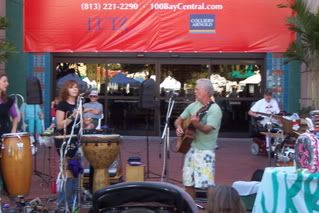
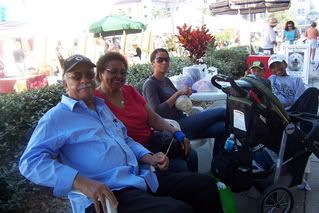
When I visited the market it was extremely busy. People came to browse or buy and then stay awhile to sit and eat some food from the many food vendors and listen to music. One family – Leslie and Pamela Best and their two children Bethia and Bryoe relocated from Long Island, NY in June 2007 to Tampa and they visited the market every Saturday. Leslie said “we come to buy flowers, and food, and stuff for our new home, and then we buy the turkey legs from Mr. I Got em and sit here and listen to the music.”


The market operates from October through May from 9:00 – 2:00 pm every Saturday.
- There were few produce vendors and even less local produce vendors
- It was not a farmers’ market
- It was very crowded, lively and fun
- There were tons of dogs of every description and size with their owners


Now this is my sort of market.
I completely forgot that I really came to buy food.
I walked around the market and came upon the market manager’s booth and introduced myself to Mark Johnson, who turned out to be one of the founders of the market. He spent some time with describing the goal of the market and how it came into being.

The market is not a farmers’ market per se. Its actual name is the Saturday Morning Market which is aptly named. Mark told me that from the beginning they knew they wanted the market to speak to the community, a place where people would feel connected and where creativity and friendships could be fostered.
The market opened in November 2002 with 10 vendors and by the end of their first season they had 45 vendors. They are able to keep the vendor fees low because there is only one paid employee while the three founders work for free; a 10x10 foot space costs $35 for the day. This year they had over 150 vendors for a 110 space market and so they rotate.
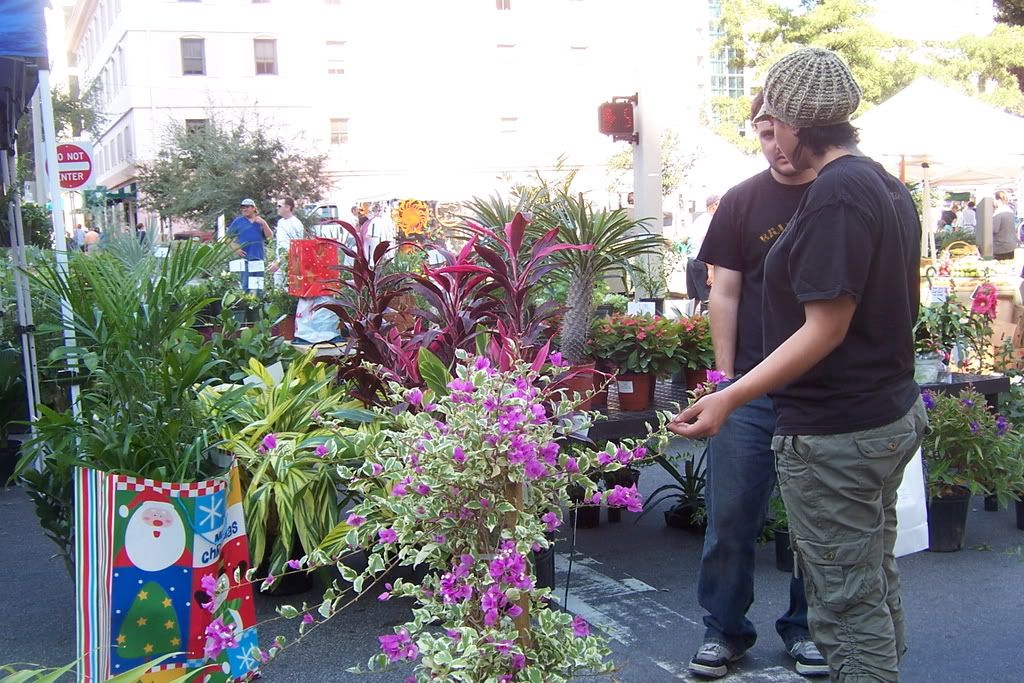
Produce and plant vendors account for 19% while the rest of the spaces are taken up by arts and crafts, prepared foods, value-added food vendors, and community organizations. In 2004, the market established a community kitchen to enable fledging vendors to meet health code requirements by cooking in a certified kitchen. All the products have to be grown, cooked or made by the vendor with the exception of environmental products or organizations such as Its Our Nature which sells organic products, the Sierra Club and the Pyrenees Rescue club, to name just a few. The craft vendors are all juried before they are accepted into the market.
Local farmers were very few even though they can try out the market for four Saturday’s at no charge, i.e. no risk to them. Small farmers are few in Florida but they do exist. Mark said that they do not understand the value of direct retail marketing. Also, they are reluctant to change their growing patterns and seem content to sell through the wholesalers in Tampa even though they could make more money at the market. Mark told me that he is trying to sell the concept of farmers’ markets to the farmers but it is difficult. He is trying to advertise in the Hillsborough County Agriculture Extension Agency’s newsletter.
I spoke to Linda from D.G. Diehl Farms

who was helping out her son; the owner of the farm. She told me that they have been selling their blueberries at the market since late 2005. They always sell everything they bring to the market. I asked Linda if her customers are price sensitive and she said “Yes, I have customers who will tell me that they can buy two cartons of blueberries from Argentina for $5 against her $4 for one carton.” Linda said that she always told them that “her blueberries are fuller, the carton is fuller, and they were picked yesterday, so that there was no comparison.”
Linda told me that they were not dependent on the market solely for their income because contracts with the cruise lines and the Ritz Carlton hotels. Their farm is in Ruskin, Florida where they own 100 acres of land.
The market has no problem from the shop vendors as the food related vendors have a stall at the Saturday market also.
When I visited the market it was extremely busy. People came to browse or buy and then stay awhile to sit and eat some food from the many food vendors and listen to music. One family – Leslie and Pamela Best and their two children Bethia and Bryoe relocated from Long Island, NY in June 2007 to Tampa and they visited the market every Saturday. Leslie said “we come to buy flowers, and food, and stuff for our new home, and then we buy the turkey legs from Mr. I Got em and sit here and listen to the music.”

The market operates from October through May from 9:00 – 2:00 pm every Saturday.
Subscribe to:
Posts (Atom)
