by Hugh Fearnley-Whittingstall
Ok! So I promise I did not buy the book I just looked at it out of interest. This is a heavy coffee table book weighing in at 543 pages. Over half of the pages are dedicated to FW’s philosophy on animal rearing, slaughtering and eating. The book is profusely illustrated from slaughtering a cow, to roasting a whole pig, to preparing the cuts of meat, and the step by step process of making a pork pie. There is a page of photographs showing the death of a cow; the first photograph shows a gun between the steers of a cow, then the dead animal with blood, it being hung, and then cut up into pieces, etc. With good reason these photographs are placed at the beginning of the book. FW is making his point right up front and the text supports those feelings. So you will either stop right there and put the book back on the shelf or not. I also think that many readers might not be happy to see a hare in a plastic shopping bag all in one piece with its head and paws. Actually to me it looks alive except of course it would not be sitting calmly in a plastic bag waiting to be dinner for someone.
FW puts forward issues that I agree with and those I don't. But at least he is talking about the issues and has very definate opinions. I particularly agree with the fact that meat should not be cheap. When we pay a lot of money for something than indeed we all ask questions about the why and the wherefore; what was the animal fed on, how did it live, and how did it die. If we are happy with the answers we pay more for the product and this is how it should be. And to answer the question "what about people with little money" just eat less and eat the cheaper cuts that most Americans don't even look at.
The book brings to the forefront yet again whether I should be eating meat. In actual fact, after looking at these pictures I have to ask myself if taking the life of a perfectly healthy and happy animal to feed me, when I could eat plenty of other things is morally correct. If we were all closer to the meat that we eat I think many more people would question what they eat. So as you can see, I am completely torn in two on the issue and when it will be solved I have no idea.
Many of the recipes in the book are for 6-10 people and while it is easy to cut some recipes into a quarter, others it is not. Additionally, the meat items that he lists as cheap are not so in America. For example there is a picture showing the cost of locally farmed Lamb Shanks at three English pounds a pound (about six dollars at the current exchange rate). I pay 50-100% more depending on the farmer I buy it from. He also lists wild rabbit under cheap and pig trotters. Now the former is very expensive and the latter is impossible to find as I do not know of any butcher in or around Boston. To clarify: a butcher is a person who has the whole animal in his store/refrigerator and will cut the pieces that you want to order. I do know that I could find everything at Blood Farms in Groton, MA because it is a small family slaughterhouse.
If you want to know how to cure meats, and make sausages, pates and terrines there is a whole chapter dedicated to just that. In fact, this book is excellent for the folks who want to know how to cut up various animals and fowl and what to do with all the pieces.
Under meals that are kid friendly he has Lamb braised with stuffed vine leaves, Indian-spiced Lamb Skewers, Flying Toad in the Hole, and Souvlaki to name a few. This brought back memories of the time I invited my neighbors and their two kids to dinner. I served roast lamb, roast potatoes, and Brussels sprouts. They eat half a potato. They had never had lamb, where not sure what the potatoes were (they were roasted in the fat of the lamb until they were crisp on the outside) and obviously didn’t eat vegetables. They were much relieved when I served Apple Pie with ice cream and said “thank goodness an American dessert.” However, their smile didn’t last long as I put a dollop of ice cream on each slice of pie and then put the ice cream back in the refrigerator. Apparently they though they were going to eat the entire pint of ice cream which I planned on lasting me the month.
There are some classic British recipes that I recall as a kid. I disagree with using beef kidneys for the steak and kidney pie because I feel that they are too strong and that veal kidneys provide a much better flavor. I was happy to see Lancashire Hot Pot in the book, a dish I have fond memories of as a child. My grandmother made this for me frequently and I still remember the brown pot it was made in and how the small the kitchen was that she cooked.
Sunday, January 20, 2008


What Have They Done to My Bread?
All you need to make bread is yeast, water, and flour. Therefore, what makes sliced bread so light and fluffy and last so long? Looking at the ingredients on the plastic wrap I found a whole pile of ingredients that I had no clue what they were. My philosophy in buying food is that if you don’t know what the ingredients are you don’t buy it or eat it.
After some investigation, I found that in the late 1950s the U.S. discovered a way to avoid the centuries’ old process of making bread that required 2-3 hours of fermentation. They did this by incorporating air and water into dough and mixing it with intense energy in high speed mechanical mixers. This process however required the quantity of yeast to be doubled to make it rise; chemical oxidants to get the gas in; and hardened fat to provide the structure – without the fat, the bread collapsed in early experiments – but the process removed the intensive labor, reduced costs and provided much higher yields of bread from each sack of flour as the dough absorbed so much more water.
Chemical oxidants were incorporated into a premix of additives with soya flour as the carrier for the chemical ingredients. The improver or ‘flour treatment agent’ was the logical way to add the fats needed into the bread. Hydrogenated fat is used because of its high melting point that gives the bread the structure it needs; Hydrogenated fat contains trans-fat.
As the “process” involved it was found that emulsifiers provided a similar function to the fat. They plug the gaps, enabling the dough to retain more air while also slowing down the staling of the bread. The most commonly used group of emulsifiers in bread is the data esters, relatively novel and complex compounds, made from petrochemicals. Salt goes into the bread to add flavor, up to 0.5g per 100g for white sliced, making it a high-salt food.
In the late 1990s, many western governments banned the use of chlorine to bleach white bread which led manufacturers to find alternatives such as enzymes and other novel ingredients. Enzymes have been used for centuries in food preparation but today many of them used in baking today are produced by genetically modified organisms. It is the microorganisms that produce the enzymes however, rather than the enzymes themselves, that have been modified. As enzymes are destroyed in the baking process it does not needed to be listed on the label, because they are not there!. The bread is then finished off by spraying it with either potassium sorbate or calcium propionate – both antifungal agents which inhabit the growth of moulds. Potassium sorbate is a poly unsaturated fatty acid salt. Do you really want to eat this kind of bread?
So this is what goes into the packaged, sliced white loaf of bread but what’s taken out?
The whole grain consists of an outer fibrous layer of bran; the germ and the inner white endosperm. The bran contains the fibre, some protein, fats and minerals. The germ contains most of the oils, some protein and the highest concentration of vitamins and minerals. The endosperm is mostly carbohydrate and some protein. The oil of the whole grain has traditionally been one of the most important sources in the diet of essential fats, which are vital for a healthy brain and nervous tissue function, but when whole wheat is milled to white flour, the most nutritious part of the grain is taken away. During the milling of white flour, over twenty vitamins and minerals present in the original wheat grain are reduced by half or more.
When you stone-grind flour the grain goes in at the top and comes out the side twenty seconds later. You know you have the whole lot. Also white flour can be matured by careful storage and does not need additives and enzymes. For thousands of years grain was milled this way. It’s a relative gentle process that leaves most of the nutrients intact. But a pair of stones can only grind 250 kilos of flour an hour which is why commercial bakeries have abandoned the process. While you can get excellent bread made from scratch from local independent bakeries, most purchase their flour from the big agribusinesses such as General Mills. Make sure you know what kind of flour was used in your bread.
Don’t forget too that there is extensive use of Pesticides and Fertilizers on wheat. Some of the main chemicals (insecticides, herbicides and fungicides) used on commercial wheat crops are disulfoton (Di-syston), methyl parathion, chlorpyrifos, dimethoate, diamba and glyphosate. Although all these chemicals are approved for use and considered safe, consumers are wise to reduce their exposure as much as possible. Besides contributing to the overall toxic load in our bodies, these chemicals increase our susceptibility to neuro toxic diseases as well as to conditions like cancer. Many of these pesticides function as xenoestrogens, foreign estrogen that can reap havoc with our hormone balance and may be a contributing factor to a number of health conditions. For example, researchers speculate these estrogen-mimicking chemicals are one of the contributing factors to boys and girls entering puberty at earlier and earlier ages. They have also been linked to abnormalities and hormone-related cancers including fibrocystic breast disease, breast cancer and endometriosis.
Much of this article was rewritten or excepted from Not On The Label by Felicity Lawrence; chapter four
Sources
http://www.mercola.com/2003/jul/26/avoid_wheat.htmf
http://www.weightlossresources.co.uk/food/labelling/not_on_the_label.htm
http://www.corpwatch.org/article.php?id=11712
http://www.findarticles.com/p/articles/mi_qa3675/is_199606/ai_n8747244#continue
http://www.arrowheadmills.com/products/category.php?cat_id=63
http://commentisfree.guardian.co.uk/felicity_lawrence/profile.html
Monday, January 14, 2008
Saturday Morning Market - St. Petersburg, FL
Recently on a trip to St. Petersburg, Florida I was told about a greenmarket that was held in the town center every Saturday during the winter months. So off I went to check it out as I love fresh food and the camaraderie of farmers’ markets I paid it a visit. My first impression was::
- There were few produce vendors and even less local produce vendors
- It was not a farmers’ market
- It was very crowded, lively and fun
- There were tons of dogs of every description and size with their owners


Now this is my sort of market.
I completely forgot that I really came to buy food.
I walked around the market and came upon the market manager’s booth and introduced myself to Mark Johnson, who turned out to be one of the founders of the market. He spent some time with describing the goal of the market and how it came into being.

The market is not a farmers’ market per se. Its actual name is the Saturday Morning Market which is aptly named. Mark told me that from the beginning they knew they wanted the market to speak to the community, a place where people would feel connected and where creativity and friendships could be fostered.
The market opened in November 2002 with 10 vendors and by the end of their first season they had 45 vendors. They are able to keep the vendor fees low because there is only one paid employee while the three founders work for free; a 10x10 foot space costs $35 for the day. This year they had over 150 vendors for a 110 space market and so they rotate.

Produce and plant vendors account for 19% while the rest of the spaces are taken up by arts and crafts, prepared foods, value-added food vendors, and community organizations. In 2004, the market established a community kitchen to enable fledging vendors to meet health code requirements by cooking in a certified kitchen. All the products have to be grown, cooked or made by the vendor with the exception of environmental products or organizations such as Its Our Nature which sells organic products, the Sierra Club and the Pyrenees Rescue club, to name just a few. The craft vendors are all juried before they are accepted into the market.
Local farmers were very few even though they can try out the market for four Saturday’s at no charge, i.e. no risk to them. Small farmers are few in Florida but they do exist. Mark said that they do not understand the value of direct retail marketing. Also, they are reluctant to change their growing patterns and seem content to sell through the wholesalers in Tampa even though they could make more money at the market. Mark told me that he is trying to sell the concept of farmers’ markets to the farmers but it is difficult. He is trying to advertise in the Hillsborough County Agriculture Extension Agency’s newsletter.
I spoke to Linda from D.G. Diehl Farms

who was helping out her son; the owner of the farm. She told me that they have been selling their blueberries at the market since late 2005. They always sell everything they bring to the market. I asked Linda if her customers are price sensitive and she said “Yes, I have customers who will tell me that they can buy two cartons of blueberries from Argentina for $5 against her $4 for one carton.” Linda said that she always told them that “her blueberries are fuller, the carton is fuller, and they were picked yesterday, so that there was no comparison.”
Linda told me that they were not dependent on the market solely for their income because contracts with the cruise lines and the Ritz Carlton hotels. Their farm is in Ruskin, Florida where they own 100 acres of land.
The market has no problem from the shop vendors as the food related vendors have a stall at the Saturday market also.
When I visited the market it was extremely busy. People came to browse or buy and then stay awhile to sit and eat some food from the many food vendors and listen to music. One family – Leslie and Pamela Best and their two children Bethia and Bryoe relocated from Long Island, NY in June 2007 to Tampa and they visited the market every Saturday. Leslie said “we come to buy flowers, and food, and stuff for our new home, and then we buy the turkey legs from Mr. I Got em and sit here and listen to the music.”


The market operates from October through May from 9:00 – 2:00 pm every Saturday.
- There were few produce vendors and even less local produce vendors
- It was not a farmers’ market
- It was very crowded, lively and fun
- There were tons of dogs of every description and size with their owners


Now this is my sort of market.
I completely forgot that I really came to buy food.
I walked around the market and came upon the market manager’s booth and introduced myself to Mark Johnson, who turned out to be one of the founders of the market. He spent some time with describing the goal of the market and how it came into being.

The market is not a farmers’ market per se. Its actual name is the Saturday Morning Market which is aptly named. Mark told me that from the beginning they knew they wanted the market to speak to the community, a place where people would feel connected and where creativity and friendships could be fostered.
The market opened in November 2002 with 10 vendors and by the end of their first season they had 45 vendors. They are able to keep the vendor fees low because there is only one paid employee while the three founders work for free; a 10x10 foot space costs $35 for the day. This year they had over 150 vendors for a 110 space market and so they rotate.
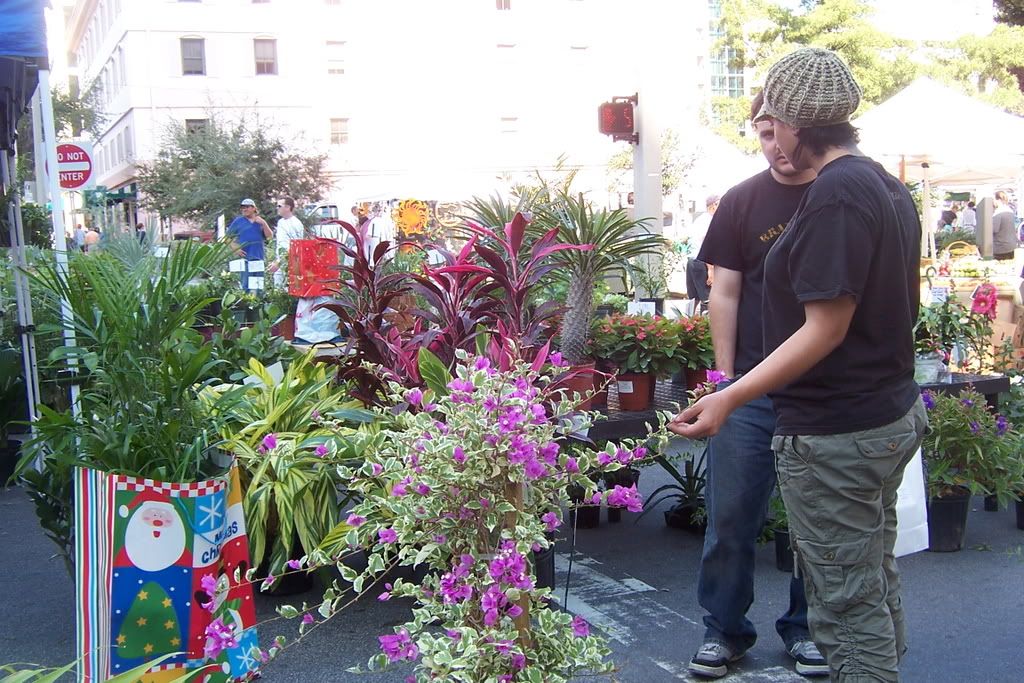
Produce and plant vendors account for 19% while the rest of the spaces are taken up by arts and crafts, prepared foods, value-added food vendors, and community organizations. In 2004, the market established a community kitchen to enable fledging vendors to meet health code requirements by cooking in a certified kitchen. All the products have to be grown, cooked or made by the vendor with the exception of environmental products or organizations such as Its Our Nature which sells organic products, the Sierra Club and the Pyrenees Rescue club, to name just a few. The craft vendors are all juried before they are accepted into the market.
Local farmers were very few even though they can try out the market for four Saturday’s at no charge, i.e. no risk to them. Small farmers are few in Florida but they do exist. Mark said that they do not understand the value of direct retail marketing. Also, they are reluctant to change their growing patterns and seem content to sell through the wholesalers in Tampa even though they could make more money at the market. Mark told me that he is trying to sell the concept of farmers’ markets to the farmers but it is difficult. He is trying to advertise in the Hillsborough County Agriculture Extension Agency’s newsletter.
I spoke to Linda from D.G. Diehl Farms

who was helping out her son; the owner of the farm. She told me that they have been selling their blueberries at the market since late 2005. They always sell everything they bring to the market. I asked Linda if her customers are price sensitive and she said “Yes, I have customers who will tell me that they can buy two cartons of blueberries from Argentina for $5 against her $4 for one carton.” Linda said that she always told them that “her blueberries are fuller, the carton is fuller, and they were picked yesterday, so that there was no comparison.”
Linda told me that they were not dependent on the market solely for their income because contracts with the cruise lines and the Ritz Carlton hotels. Their farm is in Ruskin, Florida where they own 100 acres of land.
The market has no problem from the shop vendors as the food related vendors have a stall at the Saturday market also.
When I visited the market it was extremely busy. People came to browse or buy and then stay awhile to sit and eat some food from the many food vendors and listen to music. One family – Leslie and Pamela Best and their two children Bethia and Bryoe relocated from Long Island, NY in June 2007 to Tampa and they visited the market every Saturday. Leslie said “we come to buy flowers, and food, and stuff for our new home, and then we buy the turkey legs from Mr. I Got em and sit here and listen to the music.”
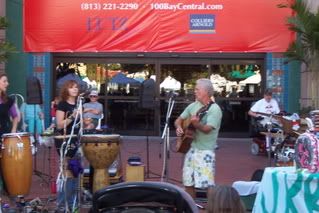
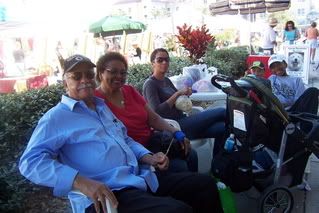

The market operates from October through May from 9:00 – 2:00 pm every Saturday.
Friday, January 11, 2008
Vegetarian Cookbook Recommendation
As a wannabe vegetarian, 2008 presents another year, another try. The key seems to be a good, everyday general cookbook; a vegetarian Joy of Cooking so to speak and perhaps one that doesn’t scream Vegetarian. To me vegetarians seem to fall into three categories: health reasons, animal rights, and religious purposes. Home cooked meals that I eat with western vegetarians are often much too high in cream, cheese, and eggs for me. As an animal lover, I have for many years bought my meat from local farms where I knew how the animal was treated and killed and I have no religious restrictions.
In the past, cookbooks have been bought, a dish or two tried, and then the book(s) collected dust on the shelf until they were given away as Christmas presents. If I invited a friend for dinner and they said they were vegetarian, alarm bells would go off in my head, my brain would freeze, I would go hot and cold; we would eat out!
I knew that my problem was how to compile a meal that was not centered on meat. For someone who loves to cook my vegetarian reportaire is awful: pasta with a sauce, Macaroni with Three Cheeses, fish cakes and baked beans and Seafood Lasagna. Later I learned that vegartarains don’t eat fish either.
In Early December, a friend suggested I attend the Boston Vegetarian Society's Holiday Vegan Dessert Party at Fiore's Bakery in JP. I then remembered what a friendly organization they were and I joined.


This was a positive step in the right direction. Then I went looking, yet again for a cookbook but one this time, that I would actually use. I first checked the “best of “ lists for vegetarian books. The most oft repeated was Mark Bitman’s How to Cook Everything Vegetarian and Veganomicon: the Ultimate Vegan Cookbook, and a couple of books by Deborah Madison. Armed with this information I went to a bookstore and started browsing.
Cookbooks are a very personal thing. It is the feel of the book, the layout of the recipes, the connection that you make to the book even before you start looking for recipes. I ended up comparing Bitman’s book to Deborah Madison’s Vegetarian Cooking for Everyone. I thought that Mark Bitman’s book felt too large, to overwhelming for me and I had the sense that I would not use it. However, I checked the Mole recipe in both books and immediately decided on Deborah Madison’s book as the list of ingredients was smaller. I also liked the feel of the book but I did not want another book just sitting on the shelf so I left it where it was.
A week later, I looked through it again and some days later yet again. Finally I bought it. Some of the aspects that “sold” this book to me was that Madison explained how to compile a vegetarian meal (a problem previously mentioned), and what wines went with what type of vegetarian food. In addition, every recipe I read where I was not sure what she meant, such as what was ricotta salata in the Beet Salad with Olives and Ricotta Salata recipe (p150); or what was roll-cut carrots for the Mixed Vegetable Stir-Fry (p.274), were located in the index. Other questions answered were “what type of breadcrumbs should I be using, fresh or dried? Madison clearly specifies which. The side bar notes giving additional tips on the dish being cooked are very useful. Lastly, there is are terrific chapters on sandwiches and soups.
The dishes range geographically across the world without you ever realizing that you just left the geographic area that you were most comfortable in. I highly recommend this book which is so much simpler than her Greens cookbook which I purchased in 1988 …oh my! The soups in that book would take half a day to make.
I am very pleased with the book as I never think "Oh! today I am being vegetarian, I just think what good, interesting food I'm eating." Now to me that is success. It is also extra special to me as it was Deborah Madison who first encouraged me to join the Slow Food organization and who also encouraged me to work with others in my town to get a farmers’ market started. Thank You Deborah!
Photographs courtsey of Randall Collura, a BVS member. His work can be seen at http://www.allrandall.com/
www.slowfoodboston.com
www.bostonveg.com
Thursday, January 10, 2008
A Conversation with Marie HIlls of Kimball Fruit Farm

What Makes a Farmer’s Market Stall Successful?
For the past two years I go two or three times a week to farmers’ markets in our area. Each time I would visit a market where Kimball Fruit Farm was, I noticed that they always had a lot of customers. As I paid more attention I noticed that not only were they busier than other stands but they would often have a line of customers while some stands only had a few, and one had almost no customers. The vegetables at each stand were all similar, so therefore something had to be different at Kimball’s and I wanted to know what it was. The only way to find out was to ask and this is what I did.
Marie Hills and I spoke one evening and it became apparent from our conversation that their success was due to:
1. Good farming practices
2. Good help
3. Personal qualities of both the family and their employees
4. Good business practices
The farm has been fortunate to have been around since the 1920s when Allen & Foster Kimball took over a burned down dairy farm and planted 80 acres of apple and peach trees. They had a small farm stand and a wholesale packing house. At this time they were 80% wholesale and 20% retail. They ran the operation this way until 1969 when Allen Kimball passed away. The land was than sold to developers and they in turn leased the land to Allen Kimball’s brother-in-law Harold Hills who had been working on the farm since 1939. In 1990, Harold sold the business to his son Carl. This was right at the time that the New England apple industry went into decline due to imports from the west coast and other locations around the world. Many apple farms closed and the Hills’ knew that their biggest threat was yet to come from China. With this in mind they decided to rip out half their apple trees and plant strawberries, blueberries, raspberries, plums, melons and a full array of vegetables with the idea that if one crop failed others would come through. At the same time they turned their business on its head by going 80% retail and 20% wholesale.
The Kimball’s have one large and one small greenhouse to get the crops started (primarily lettuce and radishes). When they are ready to transplant the produce they lay plastic down on the soil to heat it up and lay a hoop house over it. It is very labor intensive but this allows them to get their produce to market early when they can get a better price for it. If they were to do everything from seed it would delay the availability of produce, and the name of the game at farmers’ markets is having produce available both early in the season and late.
They have also been blessed with excellent soil. I am just one of many customers who tell them that their arugula is incredible but so too are their tomatoes that have been voted the best in the area for past two years in a row and their apples are fast approaching the same status.
 Kimball’s is an IPM farm and customers accept this process because they know that some things are just plain difficult to grow in New England. Kimball’s is very responsive to their customers’ requests and their low spray farm policy is just one case in point. Kimball’s puts up a sign at the market reminding their customers that they asked for low spray and so the corn may have worms in it and their customers’ don’t seem to mind because it always sells out. It was their customers who asked them for arugula and mesclun mix before they knew what it was. Later Carl Hills started reading about heirloom tomatoes and they have now been growing them successfully for over twelve years.
Based on customer demand for a certain kind of vegetable or fruit they will spend lots of time in the winter doing research. Carl Hills is currently starting to graft antique apples. They are playing around with them, not in big quantities yet because they have to feel out which ones are going to yield, which will taste good, and which are worth doing because they are always looking for that niche.
New England has been suffering from a lot less rain and more heat lately as a result of global warming. For Kimball’s this has been a double edged sword, as this year their peaches were wonderful because of the lack of rain but lack of rain stresses the trees. So they are spending more time and money moving the irrigation around to keep the trees growing. This year their corn tips were dry too. They put up signs for their customers explaining that there had been no rain for 45 days so the tips were dry but the corn was wonderful. They did this so their customers would understand that it was not old corn. They are always educating their customers.
Marie Hills feel that many things are important at a market but in particular the display and the personnel. People today are looking for that personal connection and this is what they get at a farmers’ market. All of Kimball’s staff is friendly and helpful and recognize their regular customers. Many customers will ask them how to cook so and so vegetable and Marie feels that if you say “gee, I don’t know” that will turn them off but if you say “gee, we have just started growing it so I don’t know that much about it but I tried it cooked this way and it was great, customers will really appreciate that.” More than once Marie Kimball told me that they were not just selling a product but that they believed in their products. They are passionate in what they do and take great pride in it and they believe that this comes across when they are communicating with their customers. They also put a tremendous amount of time into training their help. Marie told me that ‘when they start working for us they may not know what banana fingerlings are, or heirloom tomatoes, or what IPM is but by the time I have finished training them they do. I give them brochures to read and learn and then they have things they have to answer appropriately before I let them go to a farmers market.”
Learning the best way to display their products was a process of trail and error. Today Marie Hills says that she will watch someone at a new stand and say “gosh, if only they would display their products this way or that they would do much better”.
Here in Massachusetts the Dept. of Agriculture runs three coupon programs for women with children, elders, and low income. It is a federal program that trickles down to the states. The farmers’ love these programs because it brings people to the markets’ that would not normally come, it encourages them to eat fresh produce, it doesn’t cost them anything, and it gives the farmers’ new customers. A lot of ethnic groups are use to fresh produce in their home country so when the come to the markets with their coupons they are hooked and will come back again even when their coupons are gone.
Kimball’s have an incredibly loyal customer base and they see the same customers at two or three farmers’ markets including myself.
They hand out brochures to their customers telling them to come and visit them at the farm. They let them know that they have mountain views, lots of beautiful orchards, no animals and that they can come and bring a picnic and watch the beautiful sunsets. Through this connection they have gained a lot of additional pick your own customers.
Although they always had a farm stand it was not doing well and for this reason they concentrated most of their efforts on the farmers’ markets which accounts for 60% of their income. Once they felt secure with this side of the business they again looked at the farm stand and wondered how to promote it. They did a business plan and weighed out options on how to increase their business. Last winter they decided to invest half a million dollars to gut their old stand and rebuild in the same location.
They knew that customers had been coming into the stand and finding little to buy in the wintertime. So from the moment they opened that had a full array of everything not just their produce which meant they had to install milk coolers. Because they have a lot of customers that want their produce they labeled everything accordingly.
Marie told me that they knew they needed a bigger back room to wash and process all the produce that goes to market. With their new stand the pickups back up to the sliding door, off load the produce into the stainless steel sinks were it is washed and then it goes out right into the trucks and off to the markets’
Marie feels that with all the recalls on hamburger, lettuce, and spinach, etc. there will be stricter regulations coming down the pike which is why they built a stainless steel room. They hope that when this time comes, they will be ahead of the game and not behind. She believes there will be stricter regulations on how you pick and bag and everything. Although she believes the government will start out with the big farms in California she says it will trickle down to the smaller guy too. Marie said that “small growers always have their ears open to what is going on with the big growers in case it trickles down to us”. The farm stand accounts for 20% of their income.
In Boston they have both a tomato and an apple broker. Over the years they have developed a small niche for their heirloom tomatoes and so they are shipped out in boxes with their name emblazoned on the outside. If they have an over abundance of apples or tomatoes it is a good place to send them but they will not get the same price for it as they do at the farmers’ markets but it saves it going to waste. The wholesale business accounts for 20% of their income.
One continual problem is the shortage of labor. Marie says that Americans just don’t want to work on a farm or do any manual labor at all. For the past twenty odd years she has used the same Jamaican labor force. Without them she would be doomed.
They use QuickBooks for their accounting and they keep records of production from one block to another. A lot of that is for insurance purposes in case of a disaster. They also keep track of what they sell at each market by counting manually what goes on the truck and what comes back. This way they know what to grow and what to put on the truck for any particular month.
A happy ending or a happy beginning! In 2000, they bought all 178 acres of the family farm land from the developers. To make sure the land is never developed in the future they sold the development rights to the State of Massachusetts through the agricultural preservation program.
Greenmarket (CENYC) Union Sq
Food is nourishment for our soul, our body, and our mind that starts from the moment we pick or select our vegetables at the market, through to the rhythms of washing, dicing, cutting, kneading and sharing the end result of our labor. Food is life and it doesn’t come out of a box but from the earth. It is food that bonds us with our family and friends. It is for this reason that while I was in New York recently looking after my friends 2-year old twins I went in search of a farmers’ market. Once you have shopped at one you really don’t want to shop in a supermarket ever again.
Of course I knew about the Union Sq. Market but I wondered if there were others perhaps closer and so I called Greenmarket to find out. Much to my surprise I found that they managed 45 markets around the city and that there were 25 in Manhattan, three in the Bronx, five in Queens, 10 in Brooklyn and one on Staten Island.
The Council on the Environment of NYC (CENYC) is a hands-on non-profit that has been improving New York City's environment for over thirty years. CENYCs dedicated staff green our neighborhoods, create the environmental leaders of the future, promote waste prevention and recycling, and run the largest farmers market program in the country. These markets are a tremendous resource both to the citizens of New York as well as to the 200 or more so farmers ‘that come to the markets from Connecticut, New Jersey, New York, Pennsylvania, and Vermont. Each market has a market stand and manager(s) where they distribute literature, answer questions, cook up some vegetables for customers to taste. With the exception of Union Sq and Grand Army Plaza, the markets range in size from two to fifteen stands and there are between one and three immigrant farmers at some of the markets but not always at the same time. The busiest market is Union Sq. simply because of its location, its fame, and the number of restaurant chefs that shop there. The Grand Army Plaza market in Brooklyn is also as busy as Union Sq. if not as universally well known. You can start up a market independently of Greenmarket but if you do you miss out on their organization which is quit phenomenal. A couple of notable markets outside the system is Essex St. Market and Real Food Market.
In each of the markets I went to the friendliness of the vendors, market managers, shoppers and the store personnel were very friendly. The farmers’ at the markets ranged from ten-generation farms (quite a feat now a days) to new immigrant farmers who had been leasing their land for as little as two years. A big surprise to me, however was that only about 15-20% of the vendors were organic.
Management

Tying Greenmarket to the CENYC made them eligible to receive foundation funds. The Greenmarket Board members are comprised of Greenmarket staff/market managers, farmers, and concerned shoppers. They set the overall rules and regulations some of which are:
· The producer/farmer must be in attendance 25% of the time,
· Must grow all their produce themselves,
· It must be grown locally, and
· Staff at the stall must speak enough English to communicate with the customers.
Once a farmer has a spot with Greenmarket they keep it. An example is Hodgson Farms and Stokes Farms who have been with Greenmarkets since their inception 31 years ago. The only time a spot is vacated is when the farmer dies and there is no successor or when rules are broken and they are asked to leave. Even in the case of a divorce the couple split up the spot. Greenmarket will offer half of a 12ft frontage space for $30. While this makes it difficult for new farmers to get a spot, it is not impossible, as we will see shortly. For a farmer to obtain a spot at the Greenmarkets they must complete an application, meet the criteria mentioned above, pass an inspection, and await a space; it is as simple as that!
When Greenmarket first started operating they had problems with farmers’ buying their produce at the wholesalers in the City and reselling it at the market. Today Greenmarket has a paid farm inspector who visits the farms on a regular basis and checks that what the farmer is selling is what he is growing producing. The Greenmarket managers check the quantity and type of produce being sold at the beginning and at the end of the day. This is particular important with eggs where we hear the terms: cage free, free range, pasture and a myriad of other words to deceive the customer.
Greenmarket selects market spots based on heavy foot traffic, room for trucks to park, and community support and over half the markets are open year round. They promote the markets through advertising in local neighborhood newspapers. They also educate the consumers through tours of the market September through November, through the literature they distribute at the markets, and through their website.
They purchase a blanket insurance policy for themselves but each farmer must purchase their own policy through the New York Farmers Market Federation.
At the end of the day all unsold produce is bagged up and put on City Harvest vans by their volunteers under the supervision of the market manager(s). Last year Union Sq. Market sent 275,000 pounds of food to City Harvest. This is a significant contribution as food in the food banks in NYC has dropped by 40% due in one reason to the Farm Bill stalled in the Senate.
Greenmarket is pretty much self-funded with an operating budget upwards of $1.5 million. Farmers’ fees come close to meeting the entire amount and Union Sq. market’s income is in excess of $700,000. This money is used to manage the entire market operation; which includes dealing with nine different city agencies for the many permits that are required, marketing activities, insurance, and new initiatives such as the New Farmer Development Project (NFDP), and staff salaries. For example Union Sq. market has eight market managers.
The NFDP project was created in 2000 as a partnership between Greenmarket and the Cornell Cooperative Extension's NYC Program. The project is based in New York City and supports new farmers within the city, New York's Hudson Valley & Catskill Regions, New Jersey and northeastern Pennsylvania. The NFDP identifies, educates, and supports immigrants with agricultural experience by helping them become local farmers and establish small farms in the region. Their focus at the moment is on farmers’ from Latin American.
In 2002, Nestor Tello from Mexico and Hector Tejada from the Dominican Republic were the first two farmers to come through the program and start selling at the Greenmarkets. By 2007, the project had assisted 17 immigrant farmers’. Because of the cost of insurance the farmers are covered under the NFDP.
The market is continually evolving as funds become available. Recently they received a special grant from the city to enable them to handle the Electronic Benefits Transfer (EBT) program. They have also just received funding from the Manhattan Borough President’s Office for the purchase of a bio-diesel step-van for operations. This new van will afford Market Managers more space to store hardware such as tents and tables, cooking demonstration equipment as well as an array of supporting literature, books, merchandise and Program information.
Greenmarket has also applied for a grant from Farm Aid to bolster the education component of the Union Square Greenmarket. Currently, Union Square plays host to over 100 public and private schools each year who receive Market Tours and learn about the value of a local food system. They have also applied for a grant to initiate audio/visual programming at markets to highlight and illuminate some of the issues, challenges and successes particular to the program. If successful, Greenmarket will write, shoot and produce four, twenty-eight minute programs that will air on Manhattan Neighborhood Network Television and the Council on the Environment’s website.
Farmers and local markets
Each farmer pays between $57-60 for a 12ft frontage space although it is possible to rent half a spot. The Union Sq. market on Saturday’s costs a little more at $70 a spot. A vendor can have multiple spots based on availability and seniority. For example if a farmer started in the 80s, with 3 spots he can keep these for as long as he wants them.
The local market manager is in charge of logistics such as parking, vendor/ customer issues and questions. Occasionally an issue might come up where one farmer wants to sell another farmer’s egg and there is already an egg vendor at the market. In this case the market manager has the prerogative to say no. This only applies to the smaller markets. Union Sq. market has multiple vendors selling the same type of produce. Union Sq. Market being in the center of the city has a few unique problems such as homeliness, drugs, alcohol etc. that do impact the market. The market manger plays a significant role as he/she is the link to the farmer, the customer, and the community. It is through them that many ideas originate and who form relationships that can ultimate lead to funding for new initiatives. In the Union Sq. market the manager has been their five years while at the two I visited in Brooklyn the manager has been there one year.
The biggest headache for the farmers’ is getting into the city and parking. They get up very early, around 4:00 pm to pick their vegetables or fruit, get them loaded onto the truck(s), and ride into the city. Sometimes they can get into an accident and lose their entire load. Most farmers have set up their stalls by 5:45 am and in some areas people are coming by to shop at 6:00 a.m. The police have helped the situation by putting up Do Not Park signs right by the place that the farmers’ would be setting up their stalls. But again in the Union Sq. area cars will have parked there over night and have to be towed away by the market manager.
While Union Sq. Market is a huge and successful market there are farmers’ who prefer not to go there. The reasons can be many such as the competitiveness, they prefer the clientele at the smaller markets, there is much less hassle at the smaller markets, and there is not as much politics/friction as at Union Sq. Market.
The farms vary in acreage from one to 650 acres with 250 acres leased rather than owned. Some of the farmers’ rely entirely on the markets for their income, some have CSAs’ and some are thinking of starting one. For the immigrant farmers however, only 25% are full-time farmers while the rest have winter jobs. The non-immigrant farmers make about 70-100% of their income from the farmers’ market and the rest through selling directly to restaurants and CSAs. Almost all the farmers’ attend more than one market around the city and they told me that what customers buy varies based on the location of the market. For example one immigrant farmer told me that at Colombia University his customers buy mostly greens from him.
When I asked the farmers who ran the markets and made the rules, they said they did not know and then half of them proceeded to tell me who did. In the end it was only the new farmers to Greenmarket that did not seem to know. The majority of the farmers are at one the many markets run by Greenmarket 2-4 times a week. This is about the limit they can do based on logistics and it makes for some very long days indeed.
FARMER PROFILES

Cato Corner Farm, Colchester, CT
They are popular for the raw milk hormone free cheeses. They did not get licensed to produce cheese until 1997 and have been selling at the market since 1999. They told me that the market provides them with 70% of their income. They have just starting selling from the farm on Saturday’s and are looking into build a new space to sell their cheese and other local produce too. Apart from the market sales they also sell directly to restaurants and some specialty shops and wholesale through Artisan Made – Northeast LLC. They have no distributor.
Evolutionary Organic Farms

Kira has been growing and selling in Greenmarket for 12 years. She got a spot at the market the very first year she applied. She derives 90% of her income from the Greenmarkets and the other 10% from a small CSA at her farm. She told me that she “hasn’t seen a change in what customers want but rather a change in what they are willing to try”. Kira grows vegetables that she likes such as raddichio, asian greens, and different varieties of summer and winter squashes. For many years she said “I brought these vegetables to the market only to put them back on the van to take home again. Now I find that customers are trying them and finding that they like them even though they don’t look like they expect”.
Kira does not set a premium price for her organically grown produce. Her prices based on the work they put into a crop and by what she would be willing to pay for an item if she was a market shopper. She says that n the markets where she goes there are a lot of conventional growers and organic growers getting the same prices, and she has even seen conventional growers with higher prices, especially in heirloom tomatoes. She has never had a problem getting the price she asks for her produce.
Lynnhaven Goat Farm, Pine Bush, New York

She has been with the Saturday market for two years and the Wednesday market for seven months. Lynn told me “that she did not think that she would get a spot before she died” but luck was on her side when Coach Farms Gold Creamery sold their creamery to a big company. This made them ineligible to stay in the market and she was given their spot. She told me that Coach Farms had over 600 goats and they took in milk from two other farmers; while her operation is tiny in comparison; 70 goats. She told me that “the market had made a huge difference in her life and that the income she makes at the market supports herself, her son, and her 70 goats”. Since she has been at the market she has contracted with local chefs who come to the market and pick up the cheese. She is 100% dependent upon the market income.
Pafftenroth Gardens, Warwick, New York

They have been at the market for 18 years. They grow their produce traditionally and are perhaps the most highly rated produce farmer at the market. They have been listed in Zagats for the past five years whose participants rated the vegetables as “superior root vegetables” and “fabulous.” He has been praised by the likes of Alice Waters, and pursued by local celebrity chefs. Alex told me that his produce is the least expensive in the market and of the highest quality. He grows difference produce, and new things that the customer has not seen before. He has signs up on most of his vegetables telling customers’ what it is and what to do with it. When he comes to the markets on Wednesday and Saturday he starts his day at 3:15 a.m. when he raises and gets home at 8:30 pm. He gets 100% of his income from the market. He is a very friendly farmer indeed.
Stokes Farms. Old Tappan, New Jersey

They have been with the market for 31 years. They have a farm stand too and 17 greenhouses where they grow flowers and herbs. They told me that the flowers and herbs out of six of the greenhouses come to the Union Sq. market. They are known for the excellent fresh produce and their big beautiful herb plants. They also have a nice mix of heirloom tomatoes. The major changes that they have seen in their 31 years at the market are that customers are much more aware of local produce and what it means then when they first started. They said that quality seemed to be the first issue with customers and then price.
Tellos Green Farm, Red Hook, New York
They have been at the market six years. Nestor Tello and his wife Alejandra raise 4,000 chickens on four acres of pasture. Being the skeptical person I am I asked Nestor if they really went out side. He told me “Yes, they do. At noon I go and let them out of their barn and at dusk they all come back again. If you don’t believe me you can ask the farm manager because we are inspected.” I asked him what he fed them and he said “the eat what they can outside and then I also give them corn.”
He started at the Union Sq. Market where he met chefs who were coming to the markets to buy produce for their restaurants. Then, as chefs or other restaurant staff members moved to new restaurants or started their own restaurants, he maintained the connection and was able to develop new buyers through his old relationships. As the chefs changed restaurants they made arrangements for him to deliver to their restaurants. These restaurants pay $3.00 a dozen for his eggs which is a premium price for buying in bulk. At the market he sells his large eggs for $3.25. Nestor also has a CSA in the Brooklyn market and either he or his wife is at one of ten markets during the week. Nestor’s plans are for a totally biodynamic farm. For those who really want to know the majority of his hens are Rhode Island Reds but he also has Araucana.
It was just by chance that during the week I stopped into an organic restaurant in SOHO for lunch and the waitress told me that their egg dishes were very popular and that a farmer delivered eggs to them weekly along with honey. It turned out that this farmer was Nestor.
The most repeated question I heard from customers while I was talking to market managers in the smaller markets was “how do the prices compare.” Compare to what I thought! The market managers merely said that there were a variety of prices and they should shop around but they would not be the same as from somewhere that could buy in bulk. I thought this was a lost golden opportunity to educate the customer on food economics. However, I did find out later at the Union Sq. market that prices for produce vary wildly so the response was perhaps appropriate. According to the market managers price was the most often asked question and it came from people at all socioeconomic levels. They said that most of their customers were either middle class or those using WIC food coupons. They felt the WIC program was a wonderful situation for both the customer and the farmer. The farmers; I talked to all said that they had seen a surge in requests for organic produce and I noticed that when customers were told that there were farmers who had organic produce the question of price seemed to disappear in their eyes and body language.
Conclusion
Since Greenmarkets inception in 1976 they have managed to save many small farmers from going under. These farmers’ had tried many different methods to move their produce where they lived without success. Once they came to a NYC market they found that their produce flew off the stalls.
Shortly after this article was ready for the publisher I was directed to read the 2008 Zagats Shopping and Entertainment Guide for NYC. Many of the farmers I profiled above were listed with a rating of 27-29 out of 30 which translates as excellent in all fields. They were Cato Farms, Paffenroth, Ronnybrook, Stokes Farm, Gorzenski Ornery Farm, and Migliorelli Farms.
My comments about customers appearing willing to pay for organic food was borne out by the introduction which said that out of the 6,807 customers who participated in their survey over half said they were willing to pay more for organic, locally produced or from sustainable sources. There is definitely at opportunity for more farmers to move toward organic at the Union Sq. market where so much produce is sold. For the smaller markets however, it may be too expensive for the farmer. There is also the fickleness of shoppers who already are leaning towards local or organic/local. If the localvore wins than it will not be worth the bureaucratic cost to get certified as organic as customers will know how their farmers grow their produce.
to be published in Farmers Market Today
http://www.scissortailproductionsllc.com
Wednesday, January 9, 2008
Books to Change the Way You Think
Influential books that will change make you think about the ways we treat the ecosystem
The End of Nature – Bill McKibben. A truly remarkable book, finely written, passionately argued and impressively documented. The End of Nature tells us that an ecological holocaust is underway, and that we must act immediately. A wake up call for even the hardest of skeptics.
A Sand County Almanac – Aldo Leopold. Written from the vantage of his summer shack along the banks of the Wisconsin River, Leopold’s book mixes essay, polemic, and memoir in his book’s pages. Published in 1949, shortly after the author’s death. A classic in nature writing
The Man Who Planted Trees – Jean Giono. Written in the 1950s, and a tale whose message was ahead of its time, the Man Who Planted Trees weaves the parable of the life-giving shepherd who chooses to live alone and carry out the work of God. Over forty years the desolate hills and lifeless villages which so oppressed the traveler are transformed by the dedication of one man. All with the help of a few acorns.
Hidden Agendas – John Pilger. The book peels away the layers of deception that prevent us from understanding how the world works. He provides disturbing alternatives to mainstream explanations of world events, and leaves the reader in no doubt that power, unchallenged, seriously corrupts.
Silent Spring – Rachel Carson. One of the most influential books of the 20th century. It exposes the destruction of wildlife through the widespread use of pesticides. Despite attempts by big business to ban its sale, Carson succeeded in creating a new public awareness of the environment, which led to government policy changes and inspired the modern ecological movement.
Fast Food Nation – Eric Schlosser. Tells the story of our love affair with fast food. He visits the lab that re-creates the smell of strawberries; examines the safety records of abbatoirs; reveals why the fries taste so good and what lurks between the sesame buns – and shows how fast food is transforming not only our diets but our world.
When Corporations Ruled the World – David Korten. A thoughtful analysis of modern corporate power exposes the harmful effects of economic globalization with well-reasoned analysis. He sets out the underlying causes of today’s social, economic, environmental and political crises and outlines a strategy for creating localized economies that would empower communities within a system of global cooperation.
The Unsettling of America – Wendell Berry. A probing analysis of the way we use the land and the integral position of farming in culture at large. Berry’s suggestions for change are both radical and traditional.
Subscribe to:
Posts (Atom)
